Yes — you need a radon test for your home. The EPA and U.S. Surgeon General recommend that every home be tested for radon, no matter when it was built, where it sits, or what kind of foundation it has. Testing is the only way to know whether radon has built up to dangerous levels inside your home, because the gas is colorless, odorless, and impossible to detect without a test.
That’s the short answer. The reason it matters is simple: radon is the second leading cause of lung cancer in the United States and the number one cause among people who have never smoked. The EPA estimates radon is responsible for about 21,000 lung cancer deaths every year. A test costs little. Ignoring the question costs far more.
Key Takeaways
- Yes, you need a radon test for your home. The EPA and U.S. Surgeon General recommend every home be tested, regardless of age, location, or foundation type.
- Radon is invisible and odorless. Testing is the only way to know your levels — you cannot detect it any other way.
- The action level is 4.0 pCi/L. At or above this reading, the EPA recommends mitigation.
- Radon causes about 21,000 lung cancer deaths a year in the U.S., making it the leading cause among non-smokers.
- Testing is cheap and simple. Short-term tests take a few days; long-term tests run 90+ days for a more accurate picture.
Why Should I Test My Home for Radon?
You should test your home for radon because it’s the only way to detect a gas that’s directly linked to lung cancer. Radon has no smell, color, or taste, and it produces no immediate symptoms. A test turns an invisible risk into a number you can act on.
Radon forms naturally as uranium breaks down in soil and rock. It rises from the ground and seeps into homes through foundation cracks, gaps around pipes, sump pits, and crawl spaces. Once inside, it accumulates — especially in lower levels like basements.
The Health Risk Is Real and Documented
Radon is the second leading cause of lung cancer deaths in the United States after cigarette smoke. When you breathe it in, radioactive particles lodge in lung tissue, and over years of exposure, that damage can lead to cancer. About 2,900 radon-related lung cancer deaths each year occur among people who never smoked.
The risk compounds for smokers. Living in a home at 4.0 pCi/L carries roughly a 7 in 1,000 lifetime lung cancer risk for non-smokers — but for smokers, that risk jumps to about 62 in 1,000.
You Can’t Detect Radon Without a Test
There’s no warning sign. Breathing radon causes no short-term effects such as coughing, headaches, or shortness of breath. Lung cancer from radon develops slowly, often over decades, with no symptoms until the disease is advanced. That silence is exactly why testing is non-negotiable.
How Common Is High Radon, Really?
Elevated radon is far more common than most homeowners assume. Nearly one in 15 homes in the United States has radon above the EPA action level of 4.0 pCi/L. No region is immune.
A 2025 study from Harvard’s School of Public Health found that almost 25% of the U.S. may be exposed to radon levels above 4.0 pCi/L. The highest concentrations were mapped across South Dakota, North Dakota, Nebraska, parts of Iowa, eastern Pennsylvania, and central Ohio. But high readings turn up everywhere, including areas considered low-risk.
For perspective on what’s normal: the average outdoor air in the U.S. contains about 0.4 pCi/L, and the average indoor level is around 1.3 pCi/L. A home testing at 4.0 has roughly three times the national indoor average.
When Should I Test My Home for Radon?
Test your home for radon if you’ve never tested it, if it’s been more than two to five years since your last test, or if you’re buying, selling, or renovating. Radon levels are not fixed — they shift with soil conditions, foundation settling, and seasonal changes in how your home is sealed and heated.
Here are the clearest triggers to test:
- You’ve never tested. Every untested home is an open question.
- It’s been 2–5 years. Levels change over time, so periodic retesting matters.
- You’re buying a home. Radon is a standard item in many real estate transactions.
- You’re selling a home. A documented low reading or installed system is a selling point.
- You’re finishing a basement. Adding living space below grade increases exposure time.
- A nearby home tested high. Soil conditions don’t stop at the property line.
- You live in a high-radon region. Higher baseline risk means testing is even more important.
Does Winter Affect Radon Testing?
Yes. During winter, when ventilation is poor and homes are sealed tight, radon can build up in basements through foundation cracks and walls. This is why many short-term tests are run during colder months, when levels tend to peak.
What Kind of Radon Test Do I Need?
There are two types of radon tests: short-term and long-term. Short-term tests give a fast snapshot in a few days. Long-term tests run 90 days or more and reflect your home’s true year-round average. The right choice depends on your timeline and goal.
Short-Term Radon Tests
Short-term tests can take as little as a few days and offer a low-cost way to test for radon. Results only measure radon levels during the test period. They’re ideal when you need a quick answer — for example, during a home sale.
Long-Term Radon Tests
Long-term tests stay in place for more than 90 days and give a better picture of your family’s actual radon exposure. Because radon fluctuates by season, a long-term test is the more reliable measure of real risk.
Comparison: Short-Term vs. Long-Term
| Feature | Short-Term Test | Long-Term Test |
|---|---|---|
| Duration | 2–7 days | 90+ days |
| Best for | Real estate, fast results | True annual average |
| Accuracy | Snapshot only | Reflects seasonal change |
| Cost | Low | Low–moderate |
| EPA confirmation | Often needs a follow-up | More reliable on its own |
When You Need More Than One Test
The standard for measuring radon recommends more than one test when the lowest lived-in level is over 2,000 square feet, when different areas use different heating and cooling systems, or when the home has more than one foundation.
How Do I Read My Radon Test Results?
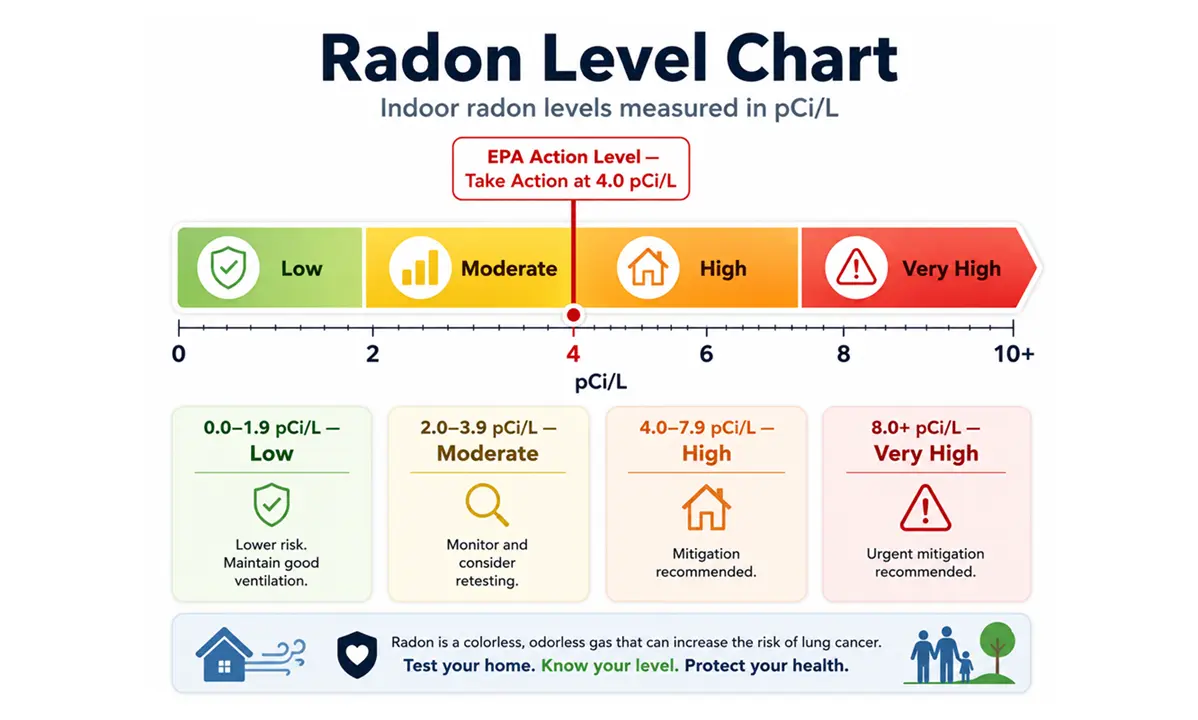
Radon is measured in picocuries per liter of air (pCi/L). The EPA action level is 4.0 pCi/L — at or above this reading, mitigation is recommended. Below it, risk drops but never reaches zero.
| Radon Level (pCi/L) | What It Means | Recommended Action |
|---|---|---|
| Below 2.0 | Low | No action; retest every 2–5 years |
| 2.0–3.9 | Gray zone | Consider fixing, especially after a long-term test |
| 4.0 and above | EPA action level | Mitigate |
The EPA is explicit that no level of radon is risk-free — 4.0 pCi/L is framed as the point to act, not the point at which safety begins. Because the risk is cumulative, a chronic average matters more than any single high reading.
It’s worth noting the global standard is stricter. The World Health Organization recommends a reference level of 2.7 pCi/L where achievable.
What Happens If My Radon Test Comes Back High?
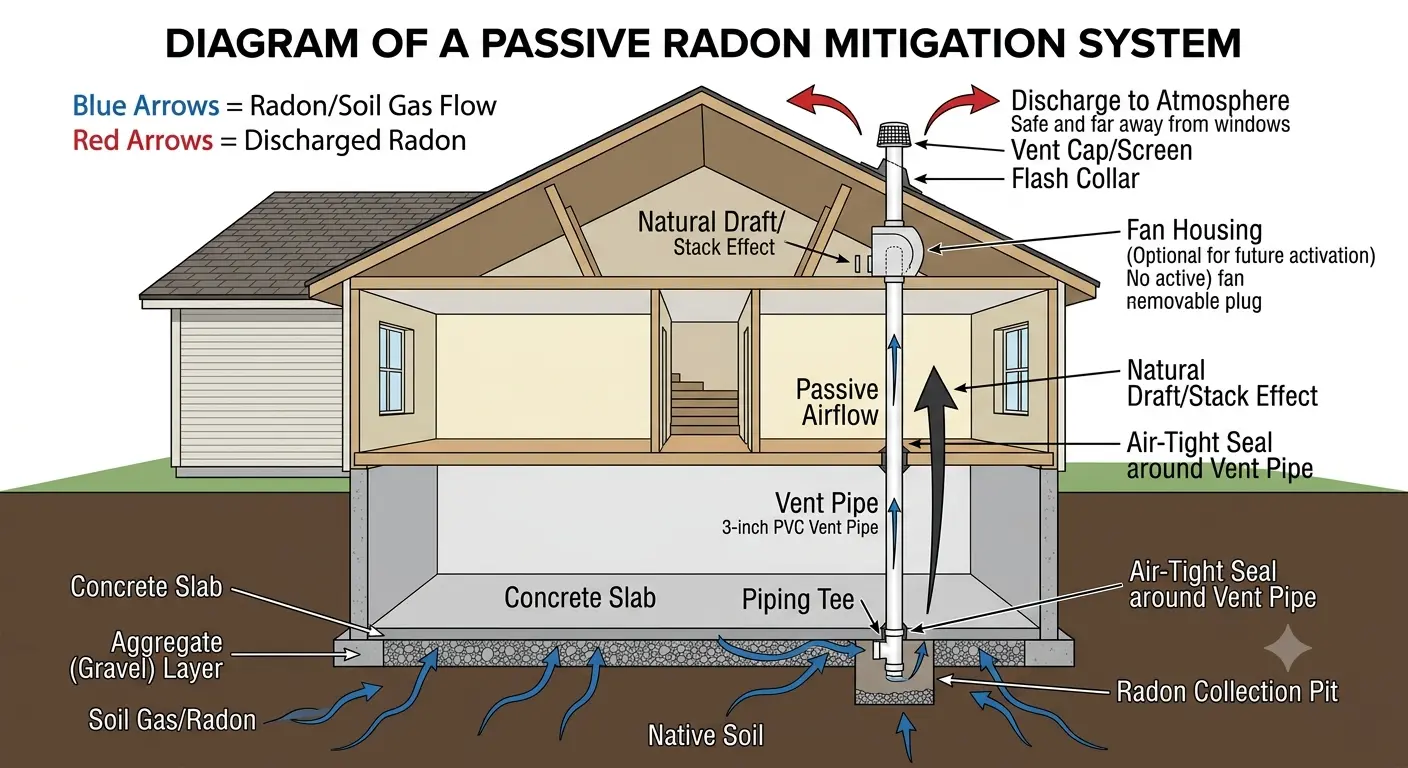
If your test comes back at or above 4.0 pCi/L, the next step is mitigation — a system that vents radon out of your home before it accumulates. Most systems reduce radon levels by 80 to 99 percent, often bringing homes below 2.0 pCi/L.
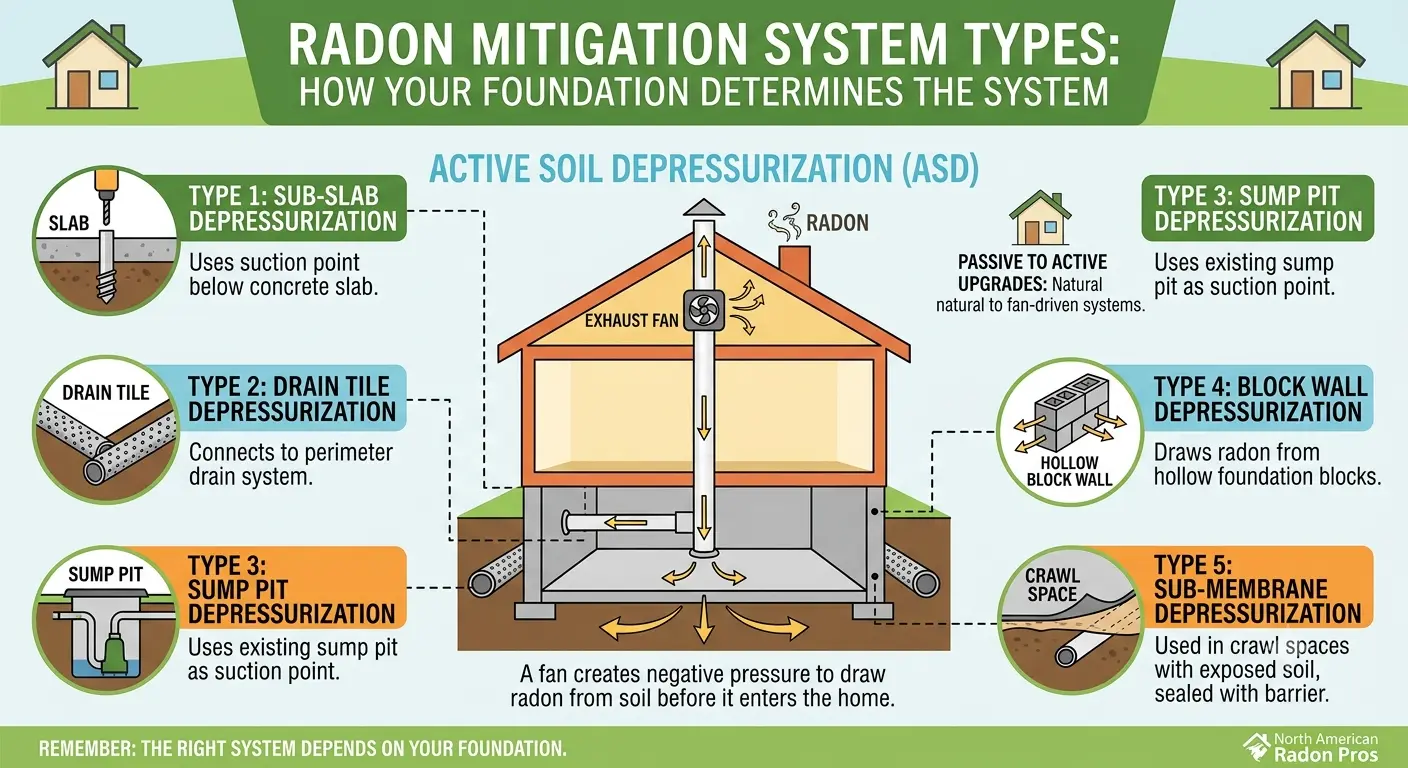
A typical mitigation system uses sub-slab depressurization: a fan draws radon from beneath the foundation and vents it safely above the roofline. Installation usually takes a single day. After the system is in, a follow-up test confirms the levels dropped.
This is where the radon pros at North American Radon Pros come in. We assess your foundation, design the right system, install it cleanly, and re-test to prove it worked. Get a Free Quote
FAQ
Do I really need a radon test if my home is new?
Yes. Radon comes from the soil, not the construction. New homes can have elevated levels just like older ones, which is why the EPA recommends testing every home regardless of age.
Can I test for radon myself?
Yes. Low-cost DIY test kits are available online and at hardware stores. For real estate transactions or confirmation of a high reading, a professional measurement is often recommended.
How much does a radon test cost?
DIY short-term kits are inexpensive. Professional testing costs more but provides documented, reliable results. Either way, testing is far cheaper than the long-term health risk of ignoring radon.
How often should I retest my home for radon?
Retest every two to five years, and any time you finish a basement, make major structural changes, or move into a new home. Levels shift over time as soil and home conditions change.
Is radon worse in basements?
Yes. Radon enters from the ground, so it concentrates in the lowest levels of a home first. Basements and slab-on-grade rooms typically show the highest readings.
My neighbor tested low — do I still need to test?
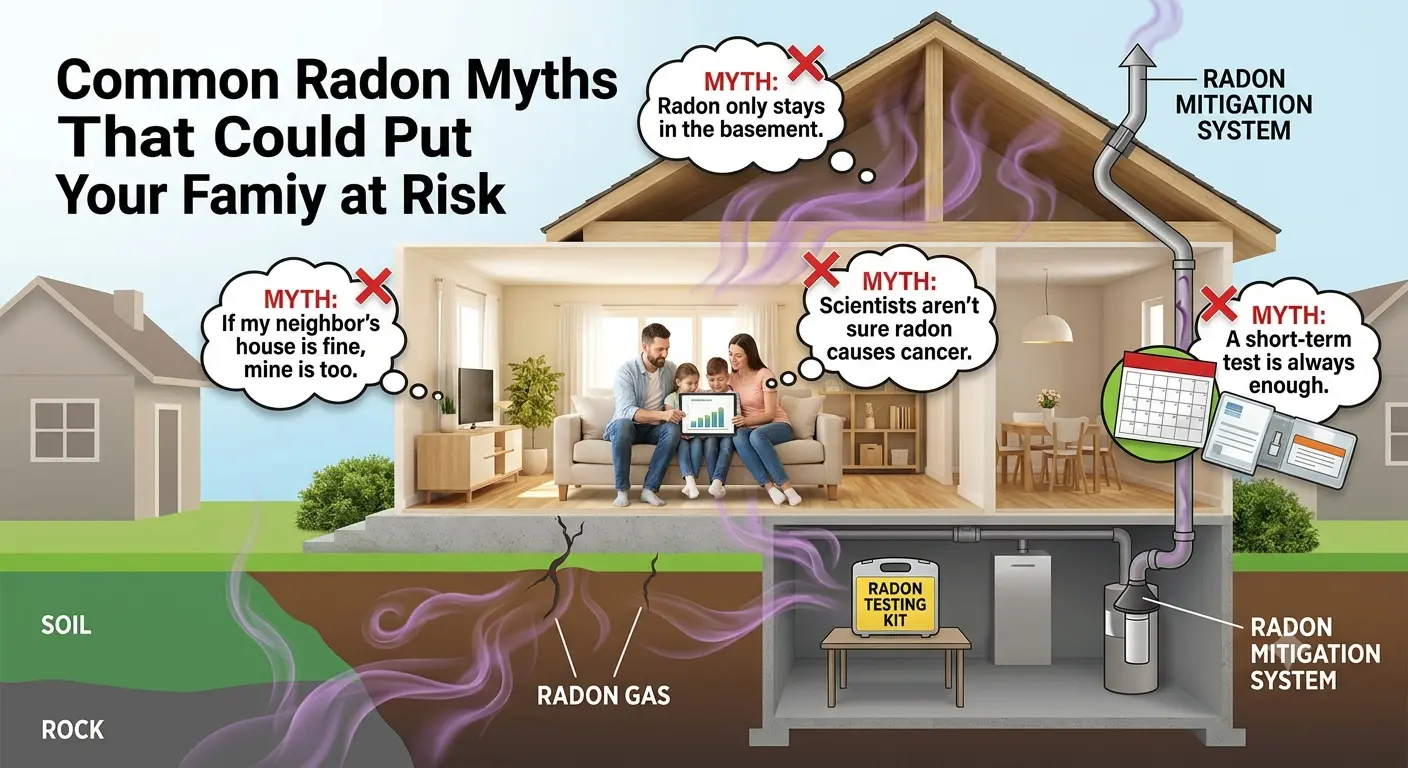
Yes. Radon levels can vary dramatically between adjacent homes due to differences in foundation, soil, and construction. A neighbor’s result tells you nothing definitive about your own home.
Does a radon test detect a problem I can actually fix?
Yes. A high reading isn’t a dead end — it’s a fixable issue. A mitigation system reduces radon by 80–99% in most homes, and results are confirmed with a post-installation test.